Downstream of Everyone
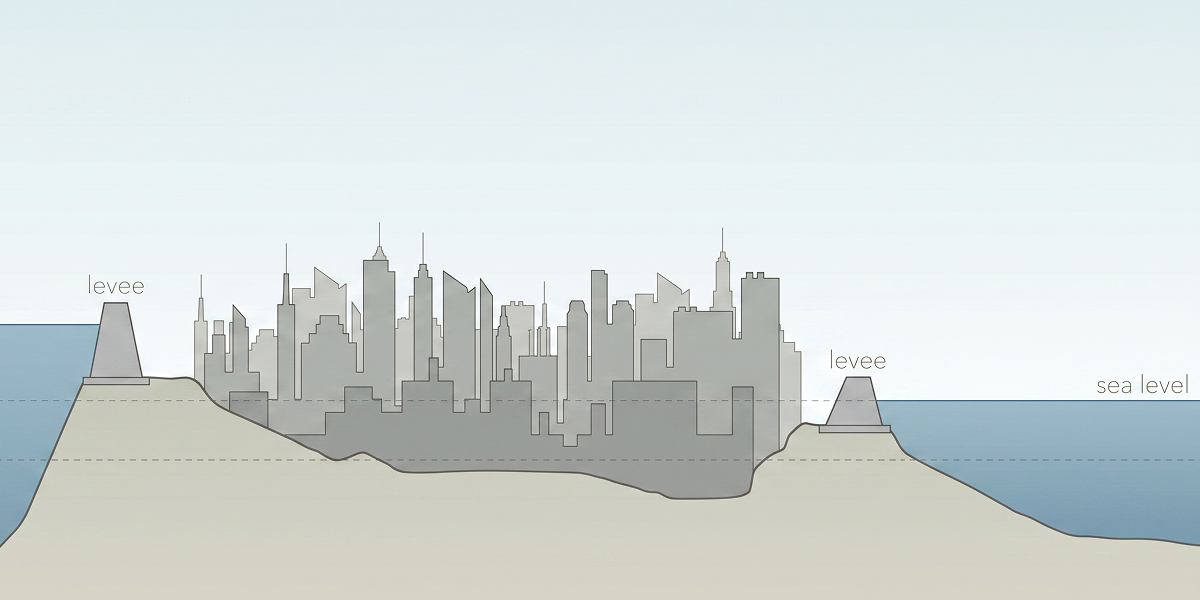
There is a city in Louisiana where the boats pass overhead. Stand in the right street in New Orleans and the Mississippi River is above you, held there by a ring of earthworks some thirty feet high. A cargo ship riding the current sits higher than your roofline. John McPhee, who wrote the definitive account of all this in The Control of Nature, compared the wall to the fortifications of a medieval town. The water wants in, and for a century and a half the United States Army Corps of Engineers has been the garrison keeping it out.
I keep coming back to a detail the philosopher Andrew Pickering pulls from that history. The Corps describes its mission, in its own documents, as "stopping time in terms of the distribution of flows." Now that is a rather remarkable sentence to find in an engineering report, don't you think? Because it's impossible. And yet, people maintain this expectation that a river will stay where it was when the maps were drawn, because an enormous amount of property and shipping is arranged around the assumption that it will.
But rivers have other ideas.
Raise the levees and the water rises to meet them. Build them higher and it climbs higher still. The Mississippi is now perched some thirty feet above a smaller river it feeds, the Atchafalaya, and left alone it would simply pour into that lower channel and reach the Gulf two hundred miles west of where it does now. Abandoning New Orleans to a trickle. So the Corps built a structure at the junction to hold the split in place. In the floods of 1973 the structure held, but only barely. Inspectors who came afterward found that the turbulence had scoured holes around its foundations "as big as football stadiums." It would never meet its original specifications again. A replacement was added at a cost of three hundred million dollars, and McPhee records that one of the engineers said about it at the time, "I hope it works."
Hope. From the person who understands the numbers better than anyone, saying quite plainly that the numbers are uncertain.
Pickering has a name for the whole century-long back-and-forth behind that sentence. He calls it the dance of agency. The engineers try something, like raising the levees, and the river takes its turn, rising higher and flooding the city. The engineers do something else, like wedge a structure into the junction, and the river does something else, tearing at the structure. "And so on, forever," Pickering writes. Neither side is in charge. It wasn't the original vision to draw up a city below the waterline, nor were the scoured-out foundations part of the design. They are what the dance produces—"a decentered interplay of the river and the people," each move emerging in real time out of the last.
Holding the river to its historic course protects the property lines that exist today. It does so by staging a far larger flood for later. The hundred-year event the Corps itself models. The estimate Pickering cites, drawn from the reporting at the time, runs to forty-five thousand dead, four hundred thousand trapped on their roofs, and seven hundred thousand driven from their homes. Keeping the present convenient costs a catastrophe deferred onto a generation that doesn't even exist yet.
Pickering finished his essay, then had to add a footnote before publication. In it, he noted that New Orleans drowned in 2005, right on schedule, though the water came from the Gulf as Katrina rather than down the river as he had expected. His comment is one sentence, "I still feel like saying I told you so." The flood came through a different door than expected. But the flood came nevertheless.
I would let this rest as one cautionary tale, but better to use the dance of agency as a way of seeing, because it leaves the same fingerprints wherever it operates.
Go west. Where, in River Notes, the anthropologist Wade Davis follows the Colorado, a river "plugged by no fewer than twenty-five dams," wrung out to supply the water of Las Vegas, Tucson, and San Diego and much of the power of Los Angeles and Phoenix. Cities, he writes, "home to more than 25 million people." Every drop has been spoken for. The river that carved the Grand Canyon now arrives at its own mouth, in Davis's words, with "its delta dry and deserted, its flow a toxic trickle seeping into the sea." A river that no longer reaches the ocean.
How does a continent's mightiest desert river get spent down to a stain in the sand? The same way the Mississippi ended up overhead. Each party narrowed the frame to its own slice—its own fields, its own grid, its own thirsty city—drew its allotment, and exported the shortfall somewhere it wouldn't have to look at it. The delta is downstream of everyone. Davis calls the whole arrangement the human quest for progress "and its inevitable if unintended effects." Nobody set out to kill the delta. It died anyway because of that same manner of seeing.
Both rivers are running the same machine. Narrow the frame to your desired outcome. Treat the world outside the frame as inert, something to be held still and dominated rather than something you are already tangled up with and answerable to. Perfect your own slice. Armor your own bank, and the water you turned away leans that much harder on the next town down. Mail the bill downstream, or down the calendar. Such a stance even feels pragmatic, the grown-up alternative to wishful thinking.
But this stance is a tactic dressed as the truth. Pickering's word for it is a veil. The habit of standing outside the world and treating it as inert stuff to be held still is something we have practiced for so long that we mistake it for the world itself. It isn't. The river's open-ended becoming is the true ontology; the engineering frame is only a move inside it, and a brittle move at that. Because it manufactures the very catastrophe it was built to prevent. The wall makes the bigger flood. The dam makes the dead river.
I write fiction for a living, but I'm a speculative design ethnographer by trade. Here is where this thinking went in me. My own debut novel runs on a best-practices binder for the end of everything—climate technology to hold the weather still, managed feelings to hold the people still, a planetary emergency to be processed on schedule, by procedure, with the appropriate forms filed. It's an absurdist satire that is both my homage to satirists like Adams and Vonnegut and a self-reflection of my experience inside the tech industry.
It took me a long time to see that I wasn't inventing anything. I was pointing the river engineers' stance at the largest possible river and writing down what it does. The managed feeling is the levee. That best-practices procedure is the scale model in the basement, the one the Corps built of the entire Mississippi drainage and tested with walnut shells until the shells rotted underwater and had to be swapped for nuggets of coal. The catastrophe is not avoided, merely rescheduled, and someone competent and sincere signs off on the schedule.
The horror, if you can call it that, is administrative rather than operatic. This horror wears a hard hat and carries a clipboard. It means well and is telling you the honest truth when it says it hopes this works. To be clear, engineers are not the villains of this story; Pickering is careful about that, and so am I. They are not acting blindly. The science is real and the math is sincere, and it all amounts to the understanding that the levees are holding back actual water tonight. But there's a trap built into the stance itself, which is what makes it worth a whole essay and, as it turns out, a whole book. You cannot fix it by hiring better engineers, because the flaw is built into the frame itself rather than the people working inside it.
There is another way to stand in a river, and the engineers themselves are starting to find it. Stop fighting the flow and learn its rhythm, use the dams to mimic a spring rise and a summer ebb instead of canceling the seasons outright. Adaptation instead of conquest. You already know the posture in your body, because you have stood in moving water and felt that it is smarter to brace at an angle than to plant your feet and dare it.
There is one more river I want to point at, and it's the largest yet. This one isn't made of water. A great deal of money is being spent right now to dam intelligence itself. To build an artificial superintelligence on the promise that, once it arrives, it will hand us the silver bullet: for the climate, for cancer, for poverty, for every disaster the present keeps kicking the can down the road to solve later. Narrow the frame to that one machine, perfect that single slice, trust the catastrophe can be engineered away before the bill comes due. It's an old stance in a lab coat instead of a hard hat. My next essay is about what you do once you stop believing the wall will hold, which is not the same as walking away from the river.
— Matthew